
SEO Explained: What It Is, Why Your Website Needs It & What You Actually Need.
SEO is simply the process of helping the right people find your website when they search for what your business does.
No magic. No secret button. No guarantee that you will suddenly appear at number one on Google. Good SEO is about making your website clear, useful, technically accessible and relevant to the searches that matter to your business.
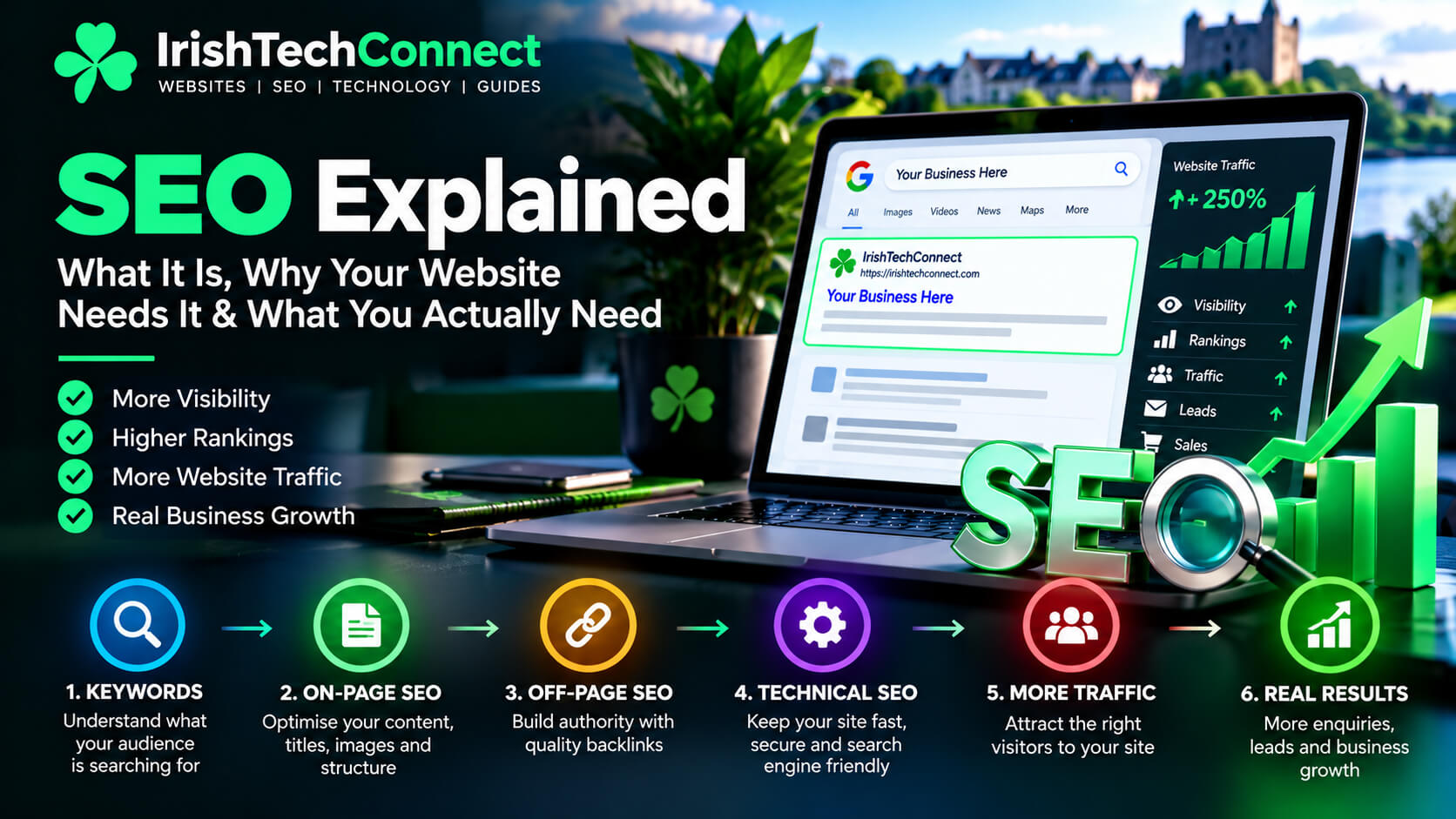 No magic · no tricks · just clarity
So, what is SEO?
SEO stands for Search Engine Optimisation. In plain English, it means improving a website so search engines can understand it and people can discover it when they search for relevant products, services, businesses, answers or information.
Be understood
Make your pages clear about who you are, what you offer and what each page is actually about.
Be discoverable
Make important pages accessible to search engines so they can crawl, understand and potentially show them.
Be useful
Give visitors information that genuinely answers the reason they searched in the first place.
Make action easy
Once the right visitor arrives, help them contact, book, enquire, buy or take the next sensible step.
Someone searches: “TV & Satellite Installer near Limerick”
SEO helps make sure the relevant service page clearly explains the service, the area served, the business, the next action and the important supporting information. It also helps search engines understand what that page is about. The goal is not to repeat the phrase fifty times; the goal is to make the page genuinely relevant and useful.
What actually happens behind the scenes?
Search is more than typing words into Google. Search engines need to discover pages, crawl them, understand their content, store useful information about them and decide what results are most relevant for a particular search.
SEO is not one task.
A good SEO job can involve several disciplines. Small websites often only need a sensible foundation. Larger or more competitive websites can require an entire SEO programme.
On-page SEO
Titles, headings, content, URLs, images, internal links and page structure.
Technical SEO
Crawlability, indexability, redirects, canonicals, performance, JavaScript and technical health.
Local SEO
Helping a local business communicate its location, services and real-world business details clearly.
Content SEO
Creating and improving useful content around the questions and topics relevant to the business.
Structured data
Adding appropriate structured information so search engines can better classify certain types of content.
Authority
Building legitimate visibility, reputation and relevant references rather than chasing spammy links.
Measurement
Using Search Console, analytics and business data to see what is happening and what should happen next.
Conversion SEO
Making sure the visitor can actually call, enquire, book, buy or take the next useful action.
How much SEO does a business actually need?
There is no single official worldwide system that labels SEO work as “Tier 1”, “Tier 2” or “Tier 3”. Different agencies use different names. ITC uses the following ladder simply to make the difference in scope easier for business owners to understand.
SEO Foundation
The sensible starting point for a small website.
- Page targeting
- SEO titles & descriptions
- H1 / headings
- Basic internal linking
- Indexability checks
- Basic local SEO
- Basic schema / media SEO
Growth SEO
For businesses ready to compete across a broader set of searches.
- Deeper keyword research
- Content planning
- Topic clusters
- Search Console analysis
- Local growth work
- Ongoing optimisation
Advanced SEO
For harder markets, larger sites and deeper optimisation.
- Advanced technical audits
- Large-scale internal linking
- Competitor gap analysis
- Advanced schema
- Content systems
- Authority strategy
Specialist SEO
SEO where a specific technical or commercial discipline becomes the dominant challenge.
- Technical SEO engineering
- E-commerce SEO
- International SEO
- Migration SEO
- Programmatic systems
- Complex search architecture
Enterprise SEO
Large organisations, platforms, multiple markets and large-scale search ecosystems.
- Large URL inventories
- Multiple countries / languages
- Complex systems
- Large-scale data analysis
- Governance
- Cross-team implementation
Web designer, developer, SEO specialist, SEO engineer?
These roles overlap, but they are not identical. There is no single globally enforced ladder of SEO job titles either. In the real world, the right person depends on the job.
Web Designer / Web Developer
Often responsible for making sure the site itself is built cleanly and the basic SEO foundations are implemented.
- Page structure
- Headings
- Metadata fields
- Performance basics
- Mobile / responsive UX
SEO Technician / Junior SEO
Usually works from an established process and handles repeatable SEO tasks and audits.
- Keyword / query mapping
- Metadata
- Internal links
- Basic audits
- Reporting
SEO Specialist
Works more deeply with search intent, content, local search, competitors and ongoing optimisation.
- SEO strategy
- Content planning
- Search Console
- Competitor research
- Local / commercial SEO
Technical SEO Specialist / SEO Engineer
Works at the intersection of search, web development and systems.
- Crawling / indexing
- Rendering
- JavaScript SEO
- Log / data analysis
- Large-scale technical fixes
SEO Strategist / Consultant
Owns the wider search strategy and decides what should happen, why, in what order and with what measurement.
- Roadmaps
- Prioritisation
- Business alignment
- Content / authority strategy
- Performance reviews
Senior / Enterprise SEO Lead
Coordinates large search ecosystems, multiple teams, markets and complicated technical dependencies.
- Governance
- International SEO
- Large-scale architecture
- Migration planning
- Cross-team delivery
A sensible SEO foundation for a small business website.
For many small service businesses, the first job is not a massive SEO campaign. It is getting the fundamentals right.
1. Understand the business
What does the business offer, where does it operate and what does a customer actually search for?
2. Map the important pages
Each core page should have a clear job instead of multiple pages competing for the same intent.
3. Improve titles & descriptions
Make the subject of each page obvious and make the search result useful and truthful.
4. Check technical access
Important pages should be reachable, indexable and free from obvious technical blockers.
5. Improve internal links
Connect related pages so users and search engines can understand how the site fits together.
6. Add useful local signals
Where relevant, clearly communicate business identity, service area and genuine local information.
Basic SEO should be boring in the best possible way.
It should be clear, sensible and repeatable. Your web developer or SEO specialist should be able to tell you what was changed, why it was changed and what remains outside the scope.
It should not rely on hidden text, keyword stuffing, fake reviews, artificial doorway pages, spam links or mysterious “secret Google tricks”. Those are not sustainable foundations for a legitimate business website.
SEO is not a guaranteed ranking button.
No honest SEO provider can control Google’s final ranking decisions. Search visibility can change as Google’s systems, competitors, content, user behaviour and websites themselves change.
No guaranteed #1
A responsible SEO provider cannot promise a permanent first-place ranking.
No instant result
Search systems need time to discover, crawl, process and reassess changes.
No plugin magic
A green Rank Math score is useful as a QA signal, but it is not a Google ranking score.
Real foundation
The objective is a site that is clear, useful, accessible and ready to compete properly.
Our approach: match the work to the website.
We do not believe every business needs “advanced SEO”.
A four-page local business website should not be sold the same SEO programme as a multinational e-commerce platform. The right level of work depends on the website, the search market, the competition, the business objective and the technical complexity.
Basic SEO establishes the foundation. Growth SEO expands coverage and improves opportunity. Advanced and specialist SEO tackles deeper technical, content, authority and market problems. Enterprise SEO deals with scale, governance, multiple systems and multiple markets.
The best SEO provider is not the one who sells the most work. It is the one who can identify what the website actually needs, explain it clearly, deliver it properly and tell the client what should happen next.
SEO questions business owners ask.
Do I need SEO if my website already looks good?
Yes, potentially. Design and SEO overlap, but they are not the same thing. A visually excellent website can still have unclear page targeting, weak metadata, poor internal linking or technical barriers that make search visibility harder.
Is SEO the same as Google Ads?
No. Google Ads is paid advertising. SEO is the process of improving a website so it can perform better in organic search. A business can use one, the other, or both depending on its goals.
How long does SEO take?
There is no universal deadline. Search engines need to discover and process changes, and competitive markets take longer to change than simple local searches. A sensible SEO provider should explain the work being performed rather than promise a fixed ranking date.
Can my web developer do basic SEO?
Yes, where the developer understands the fundamentals and can implement them correctly. For deeper SEO problems, an SEO specialist, technical SEO specialist or SEO engineer may be more appropriate. The required skill level should follow the complexity of the job.
What is Rank Math?
Rank Math is a WordPress SEO plugin that helps site owners and developers configure and review SEO settings. It can be useful as a control panel and QA tool, but a plugin score is not the same thing as a Google ranking.
What is Basic SEO?
Basic SEO is the foundation work: clear page targeting, titles, descriptions, headings, internal links, basic local signals, indexability checks, sitemap/canonical/robots sanity checks and sensible SEO plugin configuration. It prepares a small website for search without pretending to be a full long-term SEO campaign.
When do I need more than Basic SEO?
When the website is larger, the search market is more competitive, the site has technical problems, multiple locations or languages, e-commerce, a migration, a large content library, or a need for ongoing organic growth. At that point a deeper SEO programme is usually more appropriate.