
The Sovereign Stack.
Your phone should work for you — not the other way around. This is the complete stack of anti-surveillance apps that takes it back: every layer, verified and thriving as of October 2026.
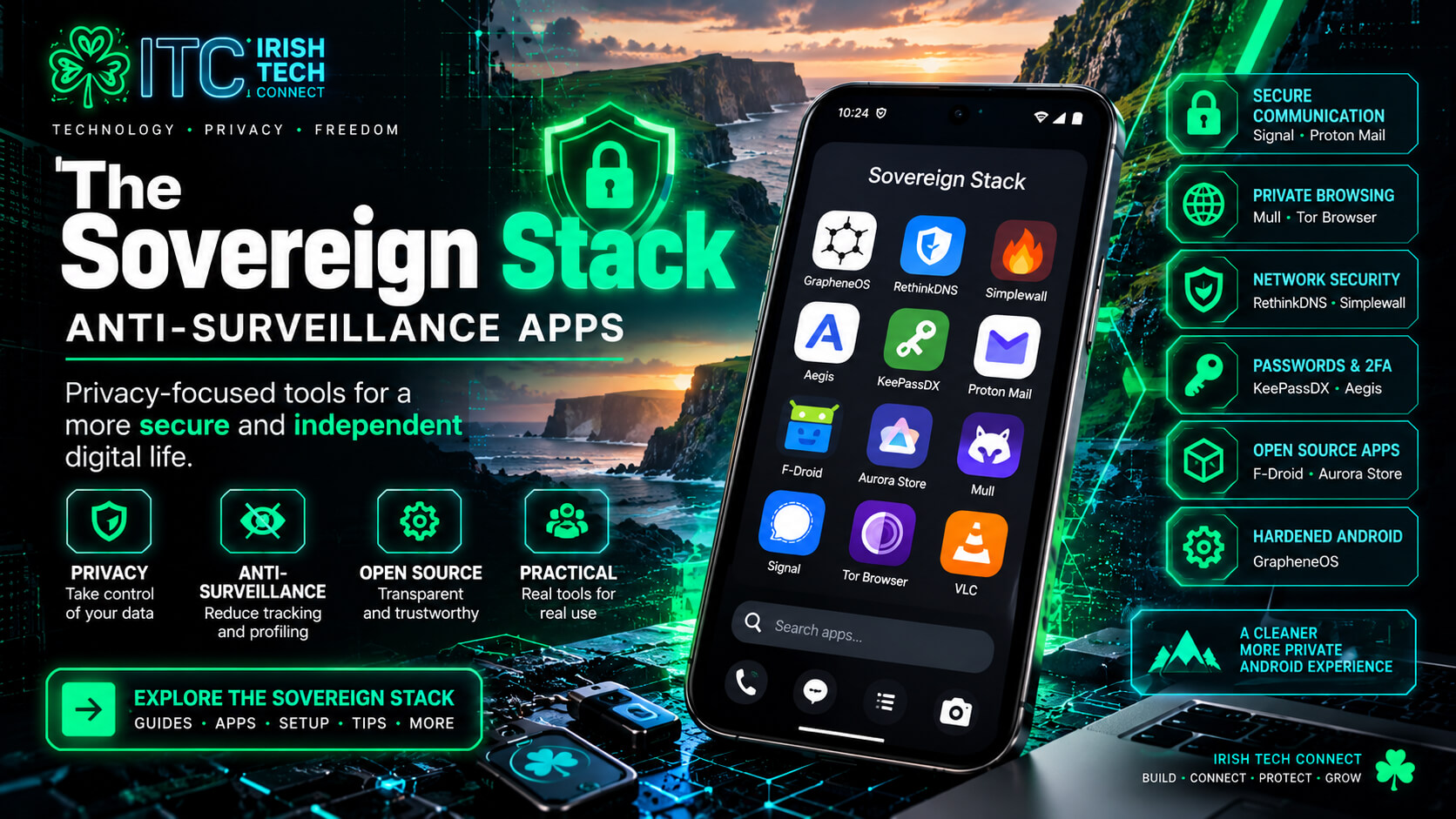 ☘️ ITC
Why right now is the best time to take control.
Here’s the honest starting picture: a stock Android phone connects to Google’s servers an estimated 4,000+ times a day — location, app usage, ad identifiers, DNS — because that’s what it was built to do. An iPhone behaves much the same toward Apple. Stock Android ships with 10–20 preloaded apps you can’t remove, most of them ad-funded. And on Chrome, Manifest V2 retired the classic uBlock Origin setup.
Here’s the great news and the reason this guide exists: every single layer of this has a free, open-source replacement — and in October 2026 the ecosystem has never been stronger. GrapheneOS is releasing faster than ever. Brave found a way to keep uBlock Origin alive on Chromium. Mullvad will literally take an envelope of cash. Signal’s protocol is now the industry standard that WhatsApp and Google build on.
The one habit that keeps this stack working: the ecosystem evolves quickly, so every tool card below carries a STATUS line, as of October 2026. Projects hand the torch to successors — DivestOS’s Firefox hardening lives on today in IronFox — and the STATUS field is how you always know you’re reading a fresh, current guide. That’s the ITC difference: we check so you can build with confidence.
4,000+ daily reports
What a stock Android phone does by default — which means every layer you replace is a massive, immediate win.
10–20 preloaded apps
Ad-funded and unremovable by default — until you switch the OS. One flash changes the whole picture.
An ecosystem in bloom
Seven layers of free, open, actively maintained tools — verified October 2026. This build has never been more capable.
One promise before we start
Every tool in this stack is here because it earns its place: open source, independently funded, actively maintained, verified October 2026. This is your stack, built for you, on hardware you own. Let’s build it.
Seven layers of anti-surveillance apps. Build them in order.
New to all this? Perfect — you get the best entry point this ecosystem has ever had. Pick Layer 1 (or skip it), then do Layers 2, 3 and 6. That alone removes most of the tracking, and each step is a win you’ll feel. The rest is mastery at your own pace.
The Operating System
GrapheneOSGrapheneOS grapheneos.org ↗
The verdict in one line: if you own a Pixel, this is the OS. If you don’t, buy a used Pixel for it. The foundation-run structure post-Micay is worth knowing — less key-man risk, less singular vision.
Legacy: Dec 2024 DivestOS retired in December 2024 after a decade of pioneering work — and its Firefox-hardening legacy lives on today in IronFox (Layer 3). That’s how open source works: projects hand the torch forward, nothing good is lost. This stack carries only current, verified tools.
The Network — DNS + VPN + Tor
Blind the pipesRethinkDNS rethinkdns.com ↗
Mullvad VPN mullvad.net ↗
The onion-routed network layer — use the Tor Browser (Layer 3) rather than standalone Tor apps; route it over or instead of a VPN depending on your threat model. Volunteer-run, free, and slower than anything else in this stack. That speed is the price of plausible deniability.
The Browser
Kill the trackersBrave + uBlock Origin brave.com ↗
The anonymized browsing gold standard — a hardened Firefox preconfigured for the Tor network. Slow, deliberately. Use it for anything where you, not just your data, need to be untraceable. October 2026: active, maintained by the Tor Project.
The Tor Browser’s hardening without the Tor network — built with the Tor Project, meant to be used with a VPN. You blend into the largest anonymity crowd without routing through Tor. Active, maintained.
The Firefox family, ranked: IronFox — community successor to Mull (DivestOS lineage), Fission enabled by default; active October 2026, with a helpful community tip: enable ResistFingerprinting habits to round out its canvas-fingerprinting protection. Cromite — hardened Chromium fork by uazo, adblock built in; actively maintained through 2026. Fennec F-Droid — vanilla Firefox without Mozilla telemetry binaries; the friendly base of the family.
Messaging
Metadata is the messageSignal signal.org ↗
SimpleX simplex.chat ↗
Hardened Signal fork with RAM-only message storage — messages that vanish from memory by design. A brilliant concept from a small team; watch this space as it hits its stride.
Fully decentralized, no phone number, no central servers to trust. In 2026 its community proved exactly what that architecture is worth: when funding ran short in April, the users stepped up in June and fully funded the project’s future. Community-owned and community-proven.
Briar — peer-to-peer over Tor and LAN, works with no internet at all. In a focused maintenance phase since July 2026, keeping core security rock-solid; still the unique pick for offline and comms-down scenarios. Threema — paid, Swiss, no phone number, audited. The choice for people who prefer to vote with their wallet.
Two-Factor & Containment
Lock the doorsAegis getaegis.app ↗
Work-profile isolation, built on Android’s own sandbox — clone apps, freeze the clones, revoke their network. Shelter is in effective maintenance mode; Insular, the F-Droid fork of Island, is the more actively maintained lineage as of October 2026.
Apps, Media & Navigation
Cut the data pipesNewPipe newpipe.net ↗
CoMaps comaps.app ↗
App Distribution & Passwords
Own the supply lineF-Droid f-droid.org ↗
Aurora Store Aurora OSS ↗
Install and update apps straight from their developers’ own GitHub/GitLab releases pages — no store, no middleman, no account. Active as of October 2026. Pair with F-Droid; use Aurora only for what neither can get.
Bitwarden: open-source, audited password manager with self-hosting option. Active, profitable, the pragmatic default. KeePassXC is the offline-only alternative if you’d rather have no server at all.
The honest ledger — and why the maths works.
STP format means we show the ledger, so here it is — the return first, the ask second. Look at the gap between them:
| Tool | The return | The ask |
|---|---|---|
| GrapheneOS | Tracking down ~95% — the single best trade on this page. Sandboxed Play is there for any rare holdout app. | A Pixel and about an hour of setup. |
| RethinkDNS + Mullvad | Encrypted lookups, hidden destinations, full network visibility on your own device. | ~€5/month and a little latency. |
| Tor | The strongest anonymity available to civilians — for free. | Patience; it’s slow by design. |
| Brave | The only Chromium browser still running full uBlock Origin in 2026. | Not touching the crypto features you never asked for. |
| Signal | Sealed sender, the industry-standard protocol — and the easiest sell to friends and family. | A phone number as your identifier. |
| SimpleX | No identifiers at all — the most private mainstream-feel messenger available. | Being the early adopter in your circle. |
| Aegis | Your 2FA vault: owned, encrypted, exportable, backed up forever. | One hour of migrating from Authy or Google Authenticator. |
| NewPipe | YouTube with zero account, zero ads, SponsorBlock built in. | An occasional short wait while volunteers ship a patch — and they always ship. |
| Aurora Store | The full Play catalog on a de-Googled phone, no Play Services. | A sandboxed login under today’s rules. |
| The whole stack | Sovereignty over your entire digital life. | An afternoon of setup and the STATUS-line habit. A bargain. |
Know the playbook — then block it, layer by layer.
🛰️ The OS layer
Stock telemetry SDKs connect from inside the OS itself, even when the phone is “idle.” GrapheneOS turns that off and hands you per-app network + sensor control — the hooks simply stop working.
🌐 The network layer
Your ISP sees your DNS lookups and destination IPs by default. Encrypted DNS blinds the lookup; Mullvad hides the destination; Tor hides both you and the destination from each other. Your move: never type an identifier into a page you want to stay anonymous on.
The browser layer
Trackers moved past cookies years ago — canvas fingerprinting, audio fingerprints, behavioral timing. uBlock Origin removes the trackers; Tor/Mullvad Browser’s uniformity defeats the fingerprinting; Brave Shields handles both well for daily use. Your move: compartmentalize your logins.
✉️ The messaging layer
The modern playbook reads metadata — who, when, how often — not message bodies. Signal’s sealed sender strips the sender from visible metadata; SimpleX removes the user identifier entirely; Briar removes the server. Your move: bring the people who matter with you.
📊 The app layer
Advertising SDKs inside “free” apps are among the world’s largest data brokers. F-Droid builds from source without them; Obtainium goes straight to the developer; Shelter/Insular sandboxes what you keep. Your move: a quick monthly permission audit — it takes two minutes.
The Three Questions, applied to the full stack.
Can you read the source? Yes — every headline tool above ships its code. F-Droid even rebuilds it to prove the binary matches.
Can you pay in cash? Yes for everything except a Mullvad subscription you choose to pay by card — and Mullvad takes literal envelopes of cash.
Can you leave tomorrow? Yes — numbered accounts, no-lock formats, reproducible builds, unlocked bootloaders. Nothing in this stack holds your data hostage.
| Layer | The ranked pick — October 2026 |
|---|---|
| 1 · OS | GrapheneOS (Pixel) — no contest, no successor |
| 2 · Network | Mullvad + RethinkDNS — the audited and the open |
| 3 · Browser | Brave + uBO for daily, Tor Browser for when it matters |
| 4 · Messaging | Signal for people, SimpleX for privacy, Briar for when the grid is down |
| 5 · 2FA | Aegis, with an exported, printed backup |
| 6 · Apps | F-Droid first, Obtainium second, Aurora Store to fill the gaps |
| 7 · Maps/Media | CoMaps and NewPipe — independence worth an occasional patch-wait |
The final word
Every tool here is free or near-free, and every one of them exists because volunteers and small foundations decided your data was worth defending. When projects hand the torch to successors, when communities fund the tools they love — that’s this ecosystem renewing itself, exactly as it has for two decades. The stack grows because people like you install it, use it, and — when they can — support it.
The pattern in one breath.
Every layer of a stock phone was built for someone else’s business model — and every layer has an open replacement built by people who believe your phone should serve you. Swap the layers one at a time, enjoy each win as it lands, and check the STATUS lines to stay current. Sovereignty was never a product. It’s a habit — and it feels great.
Which layer are you claiming first?
Drop a comment with your pick, bookmark this page, and share it with the one person in your life who deserves a phone that works for them.
VERIFY. BUILD. STAY SOVEREIGN.
~ ITC | Sentinel-DevOps | IrishTechConnect
Every claim, checked.
- GrapheneOS — OS layer, hardening model, sandboxed Play
- Mullvad VPN — no-log model, audits, cash payments
- RethinkDNS — firewall/DNS, RPN tier
- Brave — Manifest V3 and extension support
- Signal · SimpleX — protocol audits and metadata model
- Briar — maintenance mode announcement (2026)
- DivestOS ends after a decade (Dec 2024)
- Session avoids shutdown as community donations save the project (2026)
- Android Authority — open-source apps and Google’s sideloading crackdown
- LWN — CoMaps emerges as an Organic Maps fork
- Aegis releases · F-Droid
STATUS lines reflect the position as of October 2026 — this guide gets refreshed as the ecosystem evolves, so you’re always reading the current picture.