
How Long Does It Take To Build a Website?
How long does it take to build a website? A realistic project timeline depends on scope, functionality, content readiness and how quickly decisions are made.
There is no honest one-size-fits-all answer. A focused one-page launch site and a multi-product e-commerce platform may both be called “a website”, but their delivery requirements are completely different. ITC therefore estimates projects by scope and complexity, not simply by page count.
ITC planning principle: the timelines on this page are planning estimates, not guaranteed launch dates. They assume the agreed scope is stable, required content/assets are supplied, access credentials are available, and client approvals/feedback are provided within the agreed review window.
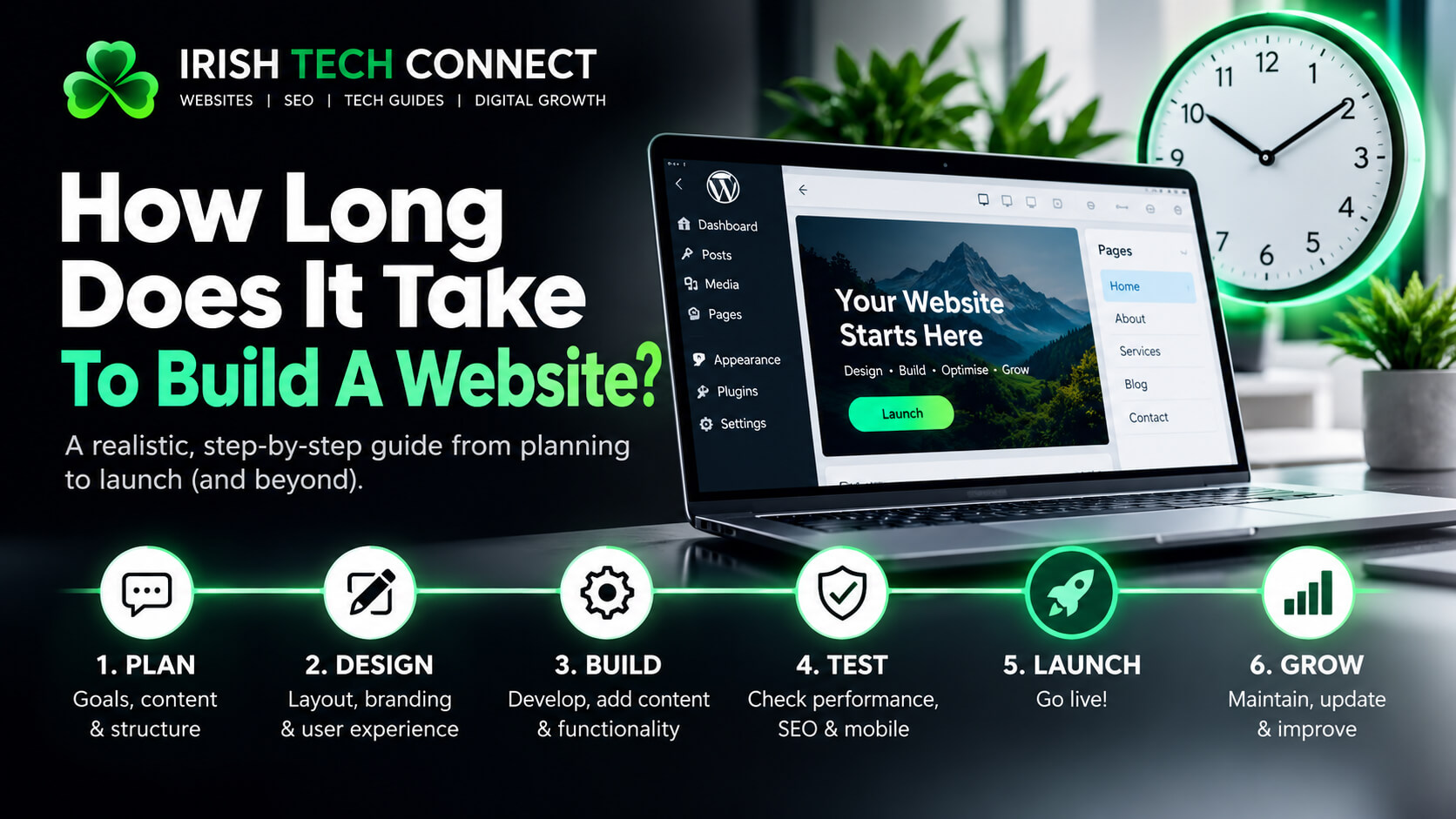 Scope sets the clock · clarity keeps it
The Market Picture
Current 2026 published guidance from Irish and international web providers shows a wide range. The important pattern is consistent: simpler brochure sites can be delivered in days or a few weeks, while e-commerce, integrations and bespoke systems expand the schedule substantially.
Common published range for a focused landing/one-page site when copy, assets and approvals are ready.
Published ranges vary because “business website” covers very different scopes, from template-adjacent builds to custom CMS projects.
Product catalogues, checkout, payments, shipping, integrations, testing and custom workflows add significant delivery time.
Published 2026 Benchmarks
These are examples of current public timelines and pricing positions we found. They are evidence for market context, not claims that every provider follows the same process.
| Provider / source | Published project range | Published price / position | Useful signal for ITC |
|---|---|---|---|
| Web Pixels — Ireland | Up to 5 pages: about 1 week | €999 incl. VAT | Fast, tightly scoped package delivery is being openly advertised in Ireland. |
| Grange Web Design — Dublin | 4–5 page starter: 2–3 weeks | From €700 | Another Irish benchmark for a small brochure-style site. |
| Web Pixels — Ireland | E-commerce: about 3–4 weeks | €1,999 incl. VAT | Shows how a constrained store scope can launch considerably faster than a bespoke commerce build. |
| Shuppa — Ireland market guide | 3–5 pages: 2–5 weeks; 6–12 pages: 4–8 weeks; e-commerce: 8–14 weeks | Market ranges rather than a single package | Supports a scope-based rather than page-count-only pricing model. |
| Laois Web Design — Ireland | Starter up to 5 pages; booking and shop treated as additional scope | Starter €749–€1,000 | Useful local signal: functionality such as booking is priced as an add-on rather than hidden inside page count. |
| ZevGeeks — 2026 guide | 5–10 pages: 2–6 weeks; CMS marketing site: 6–10 weeks; e-commerce: 6–12 weeks | Fixed-price projects often 2–4 weeks at their end | Confirms that competent small-agency delivery can be fast when scope and client decisions are controlled. |
| Hawd Design — 2026 guide | 5-page: 6–8 weeks; 10-page CMS: 8–12 weeks; e-commerce: 6–10 weeks | Timeline-focused benchmark | Shows the higher end of professional process-heavy delivery. |
| Podium Design — 2026 | Up to 5 pages: 2–3 weeks; 10+ pages: 4–6 weeks; e-commerce: 6–8 weeks | Based on 100+ WordPress builds, per its published article | Strong reference for a lean WordPress delivery model. |
How Long Does It Take to Build a Website? What Actually Happens
Professional proposals normally break the project into delivery phases. These names are worth learning because they describe the actual work happening behind the scenes.
01 — Discovery & Project Scoping
We establish the business objective, target audience, required pages, functionality, integrations, technical constraints and acceptance criteria before committing to the build.
02 — Information Architecture & Sitemap
We define how content is organised: page hierarchy, navigation, URL structure and the logical journey from entry point to conversion.
03 — Wireframing & UX Planning
For larger or more bespoke projects, low-fidelity layouts establish hierarchy, content blocks, calls-to-action and interaction patterns before visual styling is finalised.
04 — UI Design & Visual System
The visual layer is established: typography, colour system, spacing, components, imagery, responsive states and brand treatment.
05 — Development & CMS Configuration
The approved design becomes a functioning website. This can include WordPress/Blocksy configuration, custom HTML/CSS/JS, templates, forms, CMS content structures and third-party integrations.
06 — Content Population & Technical SEO
Approved copy, imagery and media are placed into the site while technical foundations such as page titles, metadata, heading structure, image attributes, internal linking and indexing controls are addressed.
07 — QA, Testing & User Acceptance
The site is checked across browsers, screen sizes and core user journeys. Forms, links, navigation, responsiveness, performance, accessibility basics and integrations are verified before launch.
08 — Deployment & Launch
The approved build is moved into production. Typical work can include final backups, DNS changes, SSL verification, cache/CDN checks, analytics verification and production smoke testing.
09 — Post-Launch Hypercare
A short period of heightened observation after launch catches real-world issues that may not appear in staging. It is also the point where small launch adjustments can be handled cleanly.
ITC Planning Ranges
Based on the current market evidence above and ITC’s existing package structure, these are the ranges I recommend advertising publicly. They are deliberately clear without pretending every project has identical requirements.
Starter Pulse
3–7 working days€299 Once-Off · 1-page website
- Focused single-page build
- Responsive/mobile optimisation
- Basic SEO foundations
- Content and assets supplied before build
- One defined review/approval cycle
Digital Ascend
1–2 weeks€499 Standard · 3-page website
- Three-page WordPress build
- Custom email + SSL setup
- Hosting configuration
- Responsive QA and launch checks
- Support/handover included within agreed scope
Quantum Enterprise
2–4 weeks€999 Custom · 5–10 pages
- Custom page architecture and design treatment
- SEO + performance optimisation
- Booking system or online shop
- Custom email + SSL
- Hosting, support and backup configuration
Commerce / Booking Expansion
3–6+ weeksQuoted by scope · functionality-led projects
- Product catalogue or appointment workflows
- Payment gateway configuration
- Shipping/tax rules where applicable
- Integration testing and transactional QA
- Timeline expands with products, integrations and custom logic
Custom / Advanced Build
4–8+ weeksDiscovery and proposal required
- Custom integrations or APIs
- Membership, portals or complex workflows
- Advanced CMS/data structures
- Migration or substantial redevelopment
- Formal scope, milestones and acceptance criteria
Web Application / Bespoke Platform
8–16+ weeksSeparate software-development engagement
- Authentication and user roles
- Database-backed functionality
- Custom backend/API architecture
- Security and integration requirements
- Staged delivery and structured QA/UAT
Important: The ITC ranges above are proposed advertising/planning ranges, not a claim that every project will finish inside them. A project can move outside the range because of content delays, revision cycles, third-party services, migrations, integrations, technical debt, client approvals or scope changes.
What Makes a Project Faster or Slower?
Accelerators
- Approved copy and images are ready at kickoff
- Logo, brand assets and domain/hosting access are available
- One decision-maker gives consolidated feedback
- The sitemap and scope remain stable
- Third-party integrations have clear documentation
- Reviews happen inside the agreed approval window
Schedule Risks
- Late copy, photography or product data
- Repeated design changes after approval
- New features added during development
- Slow access to domains, hosting or third-party accounts
- Payment, booking or API integrations requiring external support
- Legacy websites with technical debt or migration problems
ITC Technical Vocabulary
These are the labels you will see in professional proposals, statements of work and project-management systems.
Scope / Scope of Work (SoW)
The defined boundary of what the project includes: pages, features, integrations, deliverables and exclusions.
Deliverables
The concrete outputs supplied during the project, such as page templates, configured CMS components, a live website or documentation.
Milestone
A significant checkpoint in the project, often tied to approval, payment or a completed phase.
Information Architecture (IA)
The structure and organisation of content, navigation and page relationships so users can find what they need.
Wireframe
A low-fidelity layout used to plan structure, hierarchy and functionality before detailed visual design.
UI / UX
UI is the visual interface; UX covers the broader user experience, including journeys, usability, hierarchy and interaction.
Frontend
The browser-facing layer users interact with: HTML, CSS, JavaScript and the rendered interface.
Backend
The server-side logic and systems supporting the application, CMS, database, authentication and integrations.
CMS
Content Management System. WordPress is a CMS that lets authorised users manage structured website content.
Integration
Connecting the website to an external or internal system such as Stripe, a booking platform, CRM, email service or API.
Staging Environment
A non-public environment used to build and test changes before they are released to the live production site.
Quality Assurance (QA)
Systematic testing intended to identify defects, layout problems, broken functionality and regressions before release.
User Acceptance Testing (UAT)
The client/user validation stage where the completed solution is checked against the agreed business requirements.
Regression Testing
Rechecking existing functionality after changes to make sure a new update has not broken something that previously worked.
Deployment
The controlled release of the tested website/application into its production environment.
DNS
Domain Name System. The system that maps a domain name to the relevant infrastructure and services.
SSL/TLS
The cryptographic security layer used to protect web traffic between a browser and the website over HTTPS.
Smoke Test
A quick post-deployment check confirming that critical paths such as loading, navigation and forms work after release.
Hypercare
A short post-launch period of heightened monitoring and rapid issue resolution while the new site settles into production.
Change Request / Scope Creep
A request that changes the agreed scope. Controlled change management protects both the client and developer from uncontrolled schedule and cost growth.
How ITC Should Present the Timeline
The strongest commercial message is not “we guarantee your website in X days”. It is “here is the normal delivery window, here is what happens during it, and here is what we need from you to keep it moving.”
Recommended proposal language
Estimated delivery: This project is expected to take approximately 2–4 weeks from project kickoff to launch, subject to final scope, content/assets being supplied on time, third-party dependencies and client approval cycles. The project will progress through discovery and scoping, design/build, content population, quality assurance, client acceptance and production deployment. Any material change to the agreed scope may require the delivery estimate to be revised before additional work proceeds.
Research Sources
Public 2026 sources reviewed for the market comparison and planning ranges above.
- Web Pixels — Website Design Packages for Irish Businesses — published package pricing and delivery windows.
- Grange Web Design — Dublin Website Design — published starter/growth pricing and timelines.
- Shuppa — How Much Does a Website Cost in Ireland? 2026 — Irish market price/timeline ranges.
- Laois Web Design — How much does a website cost in Ireland in 2026? — Irish starter/business/shop/booking pricing context.
- ZevGeeks — How long does it take to build a website? (2026) — project-type delivery ranges.
- Hawd Design — How Long Does It Take to Build a Website? — phase-based professional timeline benchmark.
- Podium Design — How Long Does It Take to Build a Website in 2026? — WordPress delivery ranges and scope assumptions.
- WebTeqno — Honest Timelines for 2026 — one-page, business and redesign timeline ranges.
- HyberX — What actually happens each week of a website build — discovery, content, design, build, testing and launch stages.
- Taqwanology — Website Development Timeline 2026 — phase durations for landing pages, business sites, e-commerce and applications.
Research note: Published agency timelines are not a statistically controlled industry average. They are market examples from providers publishing their own estimates. Because the ranges differ materially, ITC should advertise transparent planning bands and explain the dependencies rather than claiming a universal “average”.
Build It. Launch It. Maintain It.
A professional website is a delivery process, not just a collection of pages. ITC can scope the build, establish the architecture, develop the site, test the critical paths and move it into production.
Start an ITC Project →